Not all payment solutions are created equal.
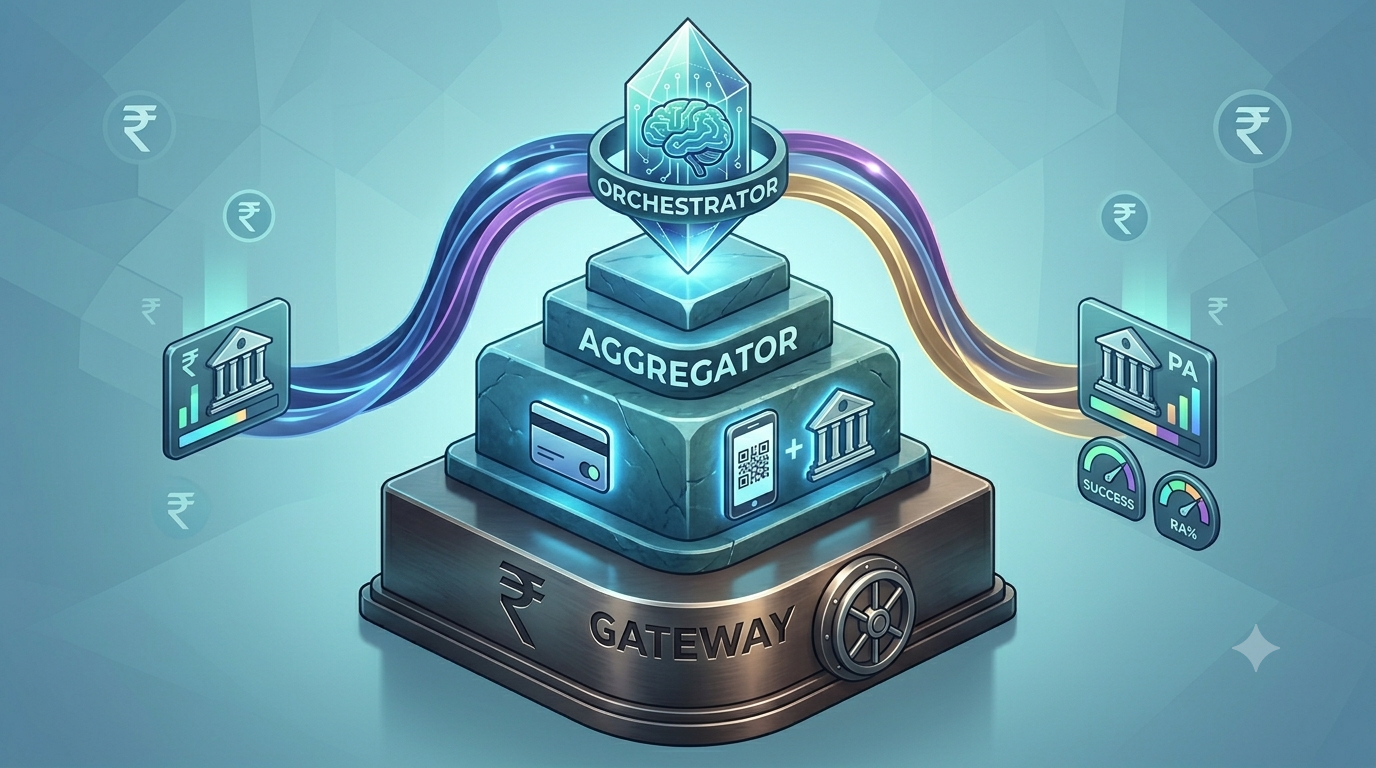
Here’s how PGs, PAs, and Orchestrators actually differ — and why it matters.
Most merchants pick the first integration that works. Smart ones understand the real differences between a Payment Gateway, a Payment Aggregator, and a Payment Orchestrator.
You’re building or scaling an online business in India. You need to accept payments. Someone tells you to integrate a “Payment Gateway”. Someone else says you need a “Payment Aggregator”. Then you hear about “Payment Orchestration” and suddenly the choices feel overwhelming.
These are not just different names for the same thing. They solve different problems at different stages of a merchant’s journey.
The Three Layers of Payment Infrastructure
| Aspect | Payment Gateway (PG) | Payment Aggregator (PA) | Payment Orchestrator |
|---|---|---|---|
| Primary Role | Technical connector to banks | Full-service intermediary + compliance | Intelligent routing across multiple providers |
| Best For | Simple websites, low volume | Most growing merchants in India | High-volume or multi-channel businesses |
| Settlement | Direct from bank (slower) | Usually T+1 or T+2 | Depends on underlying providers |
| Success Rate Optimisation | Limited | Moderate | High (smart routing + retries) |
| Compliance Burden on Merchant | High | Low (handled by PA) | Low to Medium |
| Ideal Stage | Early / Testing | Growth stage | Scale stage (₹10Cr+ monthly) |
This is a simplified view. Real-world performance depends on the specific provider and your transaction mix.
Payment Gateway (PG) — The Basic Connector
A Payment Gateway is the most fundamental layer. It securely collects payment information from the customer and passes it to the acquiring bank or card network for authorization.
When it makes sense: Very early-stage businesses, simple websites, or when you already have direct bank relationships and want minimal overhead.
Limitations: You usually need to integrate separately with each bank or card network. Settlement can be slower, and you carry more compliance responsibility.
Payment Aggregator (PA) — The Most Common Choice in India
In India, a Payment Aggregator is a regulated entity (licensed by RBI) that acts as a single intermediary between you and multiple banks. You integrate once with the Aggregator and gain access to multiple payment methods (UPI, cards, net banking, wallets, etc.).
Why most merchants prefer PAs:
- Fast onboarding (sometimes within days)
- Handles KYC, compliance, and settlement
- Better success rates than basic gateways in many cases
- Unified dashboard and reporting
Popular examples: Razorpay, Cashfree, PayU, Pine Labs, PhonePe for Business, etc.
Payment Orchestrator — The Next Level
A Payment Orchestrator sits on top of multiple Payment Gateways and Aggregators. It intelligently routes each transaction to the best available provider at that moment based on rules you define (success rate, cost, speed, specific bank performance, etc.).
Key capabilities of a good Orchestrator:
- Smart routing & fallback logic
- Real-time retry across providers
- A/B testing of different rails
- Unified reconciliation across multiple providers
- Better control over cost vs success rate trade-offs
This becomes especially valuable when your monthly payment volume crosses ₹8–10 Cr or when you sell across multiple channels (website + app + quick commerce + offline).
How Merchants Should Actually Think About This
Here’s a practical way to look at it:
| Stage | Recommended Setup | Why |
|---|---|---|
| Early / MVP | Single strong Payment Aggregator | Speed of integration + low compliance burden |
| Growth (₹1–8 Cr/month) | Primary PA + secondary backup | Better success rates + some redundancy |
| Scale (₹10 Cr+/month) | Payment Orchestrator + 2–3 underlying providers | Maximise success rate, control costs, reduce dependency |
| Enterprise / Multi-channel | Full Orchestration layer | Complex routing needs across UPI, cards, BNPL, international, etc. |
Start simple. Add intelligence as you scale.
Most merchants over-engineer their payment stack too early or stay with a basic setup for too long. The right choice depends on your volume, transaction mix, and how much you care about success rate vs operational simplicity. Understand the role of each layer — then build accordingly.
Note: Exact capabilities, settlement cycles, and pricing vary significantly between providers. Always evaluate based on your specific use case and current transaction patterns.