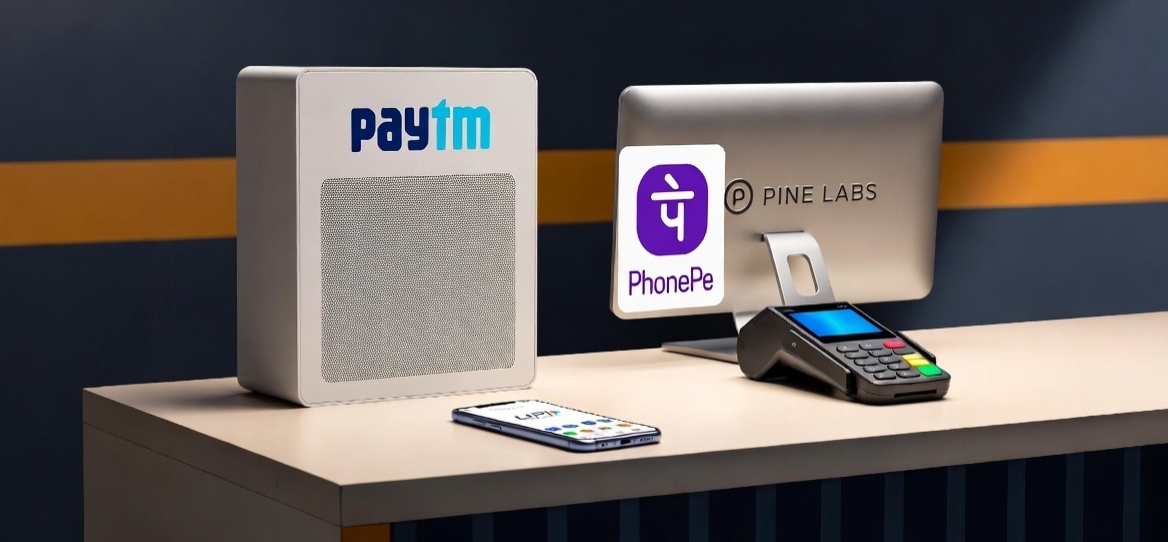
How the battle for India’s merchants actually works — and why a free payment is worth fighting over.
Walk into any shop in India today — a chai stall, a salon, a Croma showroom — and you’ll see a quiet war being fought over that counter. A Paytm soundbox here. A PhonePe QR there. A Pine Labs swipe machine at the till. None of these companies sells the shopkeeper anything they want to buy. They’re all fighting to be the pipe the shopkeeper’s money flows through. That fight has a name: merchant acquiring — and it’s one of the most fascinating, misunderstood, and ferociously contested games in Indian fintech.
Here’s the puzzle that makes it gripping. UPI is free. Zero MDR means a merchant pays nothing to accept a UPI payment. So why are Paytm, PhonePe, Google Pay, Pine Labs, and Razorpay spending thousands of crores, deploying millions of devices, and hiring armies of salespeople to win merchants who generate no direct fee? Answer that, and you understand how modern fintech actually makes money.
This is Part 1: the foundation, in plain language anyone can follow. What acquiring is, why these giants want merchants so badly, what a shopkeeper actually gets, why they switch from one provider to another (it’s rarely about price), and the clever solutions these companies built. I’ve spent my career on the partnerships side of this exact business — this is the insider’s map of the war for the counter.
First, what “merchant acquiring” actually means
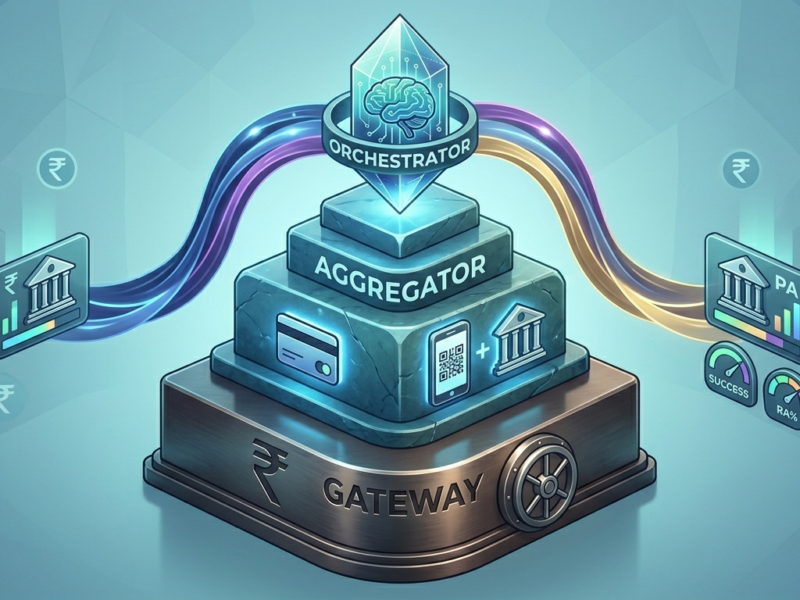
Strip away the jargon. Merchant acquiring is simply the business of signing up a shop to accept digital payments, and then processing those payments. The company that does this is the “acquirer.” When you pay a merchant, your money travels through a chain — and the acquirer is the merchant’s end of that chain.
(customer)
UPI app
UPI switch
(Paytm, Pine Labs…)
bank account
Acquiring happens in two worlds. Offline (or “in-store”) — the soundbox, the QR sticker, the card-swipe machine at a physical counter. Online — the payment gateway that powers the “Pay Now” button on a website or app. Some players dominate one world; the smartest fight to own both, because the biggest merchants live in both. (That cross-over battle is a major theme of Part 2.)
Read that last number again, because it’s the gold rush in one statistic. Out of roughly 75–80 million merchants, over 60% now accept digital payments — but only around 11% use advanced checkout devices like card machines. That gap between “accepts a QR” and “uses real merchant infrastructure” is the territory every player is racing to capture.
Why do they want merchants so badly — if UPI is free?
This is the question that confuses everyone, and the answer reveals the entire business model. These companies don’t want the merchant for the payment. They want the merchant for everything that comes after the payment. The transaction is free; the relationship is priceless. Here’s what they’re actually after:
1. The transaction data. Every payment a shop accepts tells the acquirer how much that business earns, when it’s busy, whether it’s growing or shrinking, what its cash flow looks like. That data is the foundation for the real money-maker: lending.
2. The lending opportunity — the crown jewel. Once an acquirer can see a merchant’s daily sales, it can offer that merchant a loan with confidence no traditional bank can match. A shopkeeper doing ₹2 lakh a month through a Paytm soundbox is a known, low-risk borrower. Merchant lending — cash advances, working-capital loans — is where the fat margins live in a zero-MDR world, and you can only lend to merchants you’ve acquired first.
3. Card and other paid transactions. UPI is free, but credit-card and EMI transactions at the counter still carry MDR. The acquirer earns on those. So winning the merchant means earning on the card and EMI volume even when the UPI volume is free.
4. Value-added subscriptions. The soundbox isn’t free — merchants pay a small monthly rental. Multiply a modest monthly fee across millions of devices and it becomes serious, predictable recurring revenue.
5. Ecosystem lock-in. A merchant on your platform — using your settlement, your loans, your billing tools — is a merchant who won’t leave. (Just how deep that lock-in goes is the heart of Part 2.)
Payments are the hook, not the catch. Acquirers give away the payment to win the merchant relationship — then monetize it through lending, card and EMI fees, device rentals, and software. Whoever owns the merchant’s payments owns the doorway to their entire financial life.
What does the merchant actually get?
From the shopkeeper’s side, the value has quietly exploded far beyond “accept payments.” A modern acquiring relationship bundles a remarkable stack — and understanding this stack is the key to understanding why merchants switch. Here’s what’s on offer:
| What the merchant gets | Why it matters to them |
|---|---|
| Instant audio confirmation (soundbox) | No staring at a phone; the shop hears “payment received ₹200” — huge for busy counters and for trust |
| Fast settlement (T+1, or instant) | Money in the bank next day — or the same day — instead of waiting. Cash flow is oxygen for small business |
| Working-capital loans | A pre-approved loan based on their own sales, in minutes, without paperwork or a bank visit |
| EMI at the counter | Lets customers buy bigger items in instalments — directly boosting the merchant’s sales |
| One dashboard for everything | All sales, settlements, and reports in one app — accounting and reconciliation made simple |
| Bill payments & recharges (BBPS) | The shop offers extra services and earns commission — a kirana becomes a mini service centre |
| QR + card + NFC in one device | Accept every payment type a customer might use — never lose a sale |
A concrete example to make it real. Imagine Ramesh, who runs an electronics shop. Five years ago, his card machine just took card payments and the money arrived in three days. Today, his acquirer’s device lets a customer split a ₹40,000 TV into EMIs (so Ramesh sells more), settles his money the next morning (so he can restock faster), and offered him a ₹5 lakh working-capital loan based on his sales — approved in a day, no bank visit. Ramesh didn’t switch providers for a cheaper rate. He switched because the new one helped him sell more and run smoother. Hold that thought — it’s the answer to the next question.
Why do merchants switch — when it’s rarely about price?
Here’s a counterintuitive truth I’ve seen play out repeatedly: in acquiring, price is almost never the real reason a merchant leaves. UPI is free for everyone, so there’s no price to compete on there. Card MDR is broadly similar across players. So what actually makes a shopkeeper rip out one device and adopt another? Five things, and not one is the rate card:
1. Settlement speed and reliability. If a provider’s money lands late, or reconciliation is messy, the merchant feels it in their cash flow immediately. Faster, more reliable settlement is one of the single biggest switching triggers. A shop will move for “I get my money next morning, guaranteed.”
2. Access to credit. A merchant who gets offered a timely, fairly-priced working-capital loan by one provider — when their current one offers nothing — will switch, and stay, for that loan. Lending is the stickiest hook in the entire business.
3. Device experience and uptime. A soundbox that’s loud, reliable, and works on patchy networks beats one that doesn’t. When a device fails during a sale, the merchant loses money and patience. Reliability wins counters.
4. Service and support. When something breaks, can the merchant reach a human who fixes it fast? Ground-level service — a field agent who actually shows up — is an enormous and underrated differentiator, especially in smaller towns.
5. The extra solutions. EMI options, billing software, inventory tools, loyalty, bill-payment commissions — the provider that helps the merchant grow their business, not just accept payments, earns loyalty money can’t buy.
Merchants don’t switch acquirers to save on fees. They switch to get paid faster, to get a loan they couldn’t get elsewhere, for a device that doesn’t fail, for service that shows up, and for tools that grow their sales. Compete on commercials alone and you’ll lose. Compete on the merchant’s cash flow and growth and you’ll win — and keep — them.
The solutions they actually built
This is where the real innovation lives. Faced with a free-payment world, these companies became problem-solvers for small business. The standout solutions worth knowing:
The soundbox — India’s killer hardware innovation. A cheap, SIM-enabled speaker that announces every payment out loud. It sounds trivial; it was revolutionary. It solved trust (the merchant hears the payment, so no disputes), it works without a smartphone or WiFi, and it created a daily branded presence on every counter. Paytm pioneered it and has deployed around 8.5 million devices; PhonePe has rolled out about 3.25 million.
Merchant lending — turning payment data into instant credit. The acquirer sees your sales, so it can offer a loan in minutes with repayment auto-deducted from daily collections. This is the most valuable solution of all, and the one banks structurally can’t replicate at the same speed.
EMI at the point of sale — letting customers convert a purchase into instalments right at the counter, often by entering their registered mobile number, which surfaces their bank’s EMI offers (tenure and interest rate). The customer picks an option while the merchant receives full payment upfront. This directly lifts the merchant’s average ticket size.
Affordability and gift cards — Pine Labs built much of its moat here: integrating affordability/EMI tools into its POS software, then moving into gift cards by acquiring Qwikcilver to let businesses issue prepaid cards and loyalty programs.
Instant settlement, BBPS bill payments, Cash@POS, and rich analytics dashboards — each one a reason for a merchant to choose, and stay with, a provider.
So who’s winning — and why the counter is only the beginning
By now the shape of the war is clear. Five giants — Paytm, PhonePe, Google Pay, Pine Labs, Razorpay — are spending enormous sums to win merchants who pay nothing for the core service, because the merchant relationship is the real asset. They compete not on the free payment, but on who settles money fastest, lends most readily, builds the most reliable device, and bundles the most useful tools. The merchant, in turn, has never had it better: paid faster, financed more easily, and equipped to sell more than at any point in Indian history.
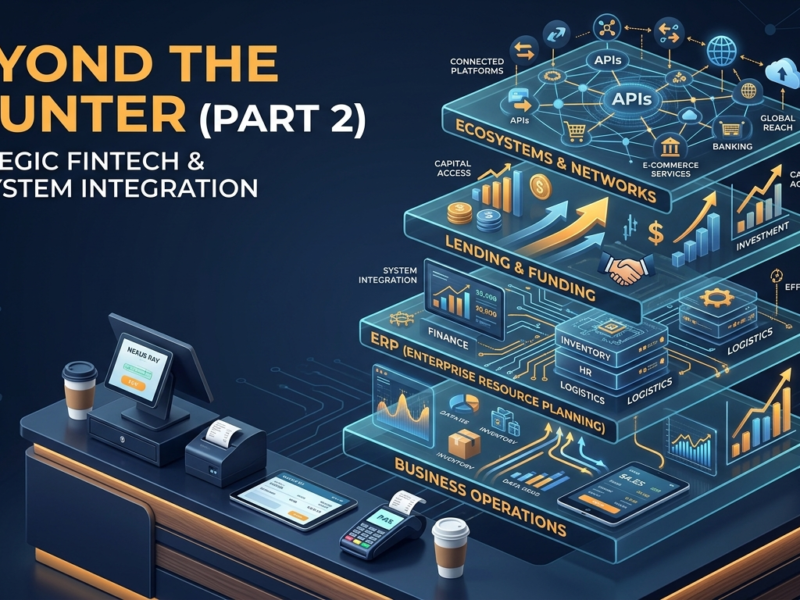
But here’s the thing — winning the counter is only the ground floor. Everything we’ve covered so far is the entry point to a far deeper and more strategic game. Because once a player has the merchant accepting payments, the real contest begins: climbing from that free transaction up into the merchant’s cash flow, their loans, their payroll, their accounting software, their ERP system, and ultimately their entire business operation.
That’s the deeper map — where payments disappear into the machinery of a business. We’ll go there in Part 2.
Beyond the Counter
The five-floor model of owning a merchant · why SMB and enterprise are two different games · how payments vanish into ERP and business operations · and how each giant turns its ecosystem into a moat.
I build interactive tools that turn the mechanics behind pieces like this into things you can play with:
- Who Pays for Your Free UPI Payment? — see exactly why merchant UPI is free and who absorbs the cost
- Interchange Waterfall Visualizer — follow a ₹1,000 card payment through every party
- No-Cost EMI & Scheme IRR calculators — the real economics behind EMI offers at the counter
Note: Market figures are drawn from public reporting and industry estimates (NPCI, company disclosures, RedSeer, etc.) as of 2025–26 and may have shifted since publication. This is analysis and commentary for general understanding, not financial or investment advice.