
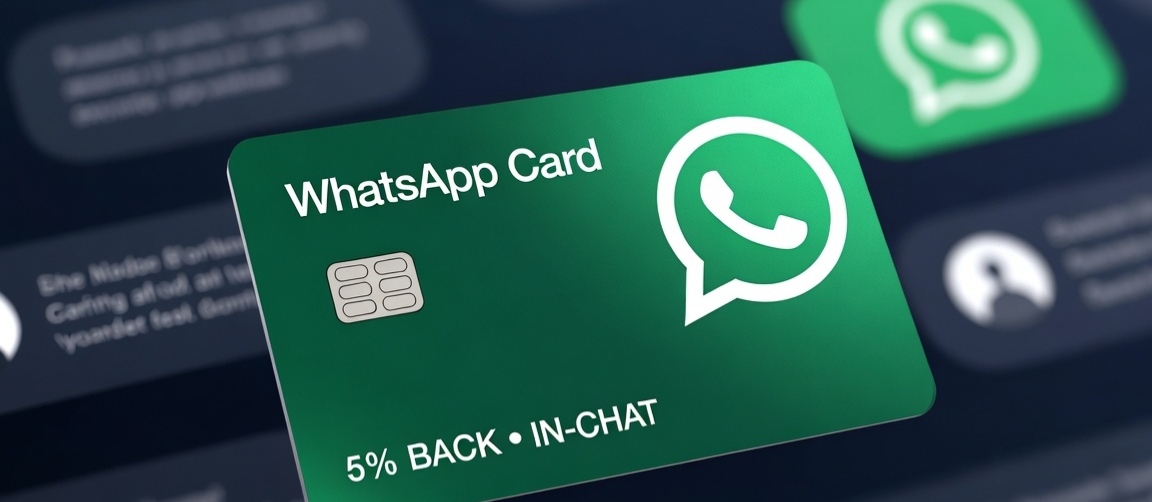
Picture tomorrow morning. WhatsApp pushes one notification to its 500-million-plus Indian users: “Your WhatsApp Card is ready. 5% back on everything. Activate in 2 minutes. Lifetime free.” No branch. No form. No plastic. Just a card, alive inside the app you already open forty times a day.
For most of the last decade, that scenario was a thought experiment — the kind of thing payments people argued about over coffee and then filed under “someday, maybe.” As of last week, it stopped being hypothetical.
Because Meta just put Kunal Shah — the founder of CRED — in charge of WhatsApp. The one Indian operator whose entire career has been about wrapping status, rewards, and habit around a credit card now runs the most-used app in the country. If you wanted to design the single person most likely to look at WhatsApp and think “this should issue a card,” you would design him. So this essay is no longer “what if.” It’s “what happens when the card guy gets the distribution.”
Let me lay out the whole blueprint — the product, the rewards revolution, the forex wedge, the bank dynamics, the threat to Amazon ICICI and the entire fintech-card wave (CRED, PhonePe, and the rest), the global ripple, and the trillion-rupee question of whether it actually works. I’ve built and scaled co-branded card programs across banks and fintechs; this is how I’d read the board.
First, why this is suddenly a real question, not a fantasy
Start with the strange fact at the centre of Indian payments. WhatsApp has total reach and almost no transactional habit. WhatsApp Pay launched back in 2018, every regulatory user-cap was eventually lifted, and yet it sits at the very bottom of the UPI table.
Sit with the irony, because it’s the key that unlocks the whole strategy. Meta just hired the founder of the app sitting at 0.68% to fix the app sitting at 0.65%. Two of the smallest players in UPI just merged leadership. That tells you the bet is emphatically not “Kunal Shah knows how to win the UPI volume war” — he didn’t. The bet is that he knows the one thing that actually moves the dial here: how to make people want to engage with money inside an app. CRED never had the most users — it had the most engaged users, \~17 million affluent Indians who turned a boring chore (paying a card bill) into a daily habit wrapped in rewards and status.
WhatsApp’s problem is CRED’s problem inverted: infinite reach, no habit. The fix Meta chose is to import the habit architect. And the most direct instrument a habit architect has for converting passive users into active financial ones is a beautifully designed, rewards-rich, instantly-issued credit card.
What the WhatsApp Card would actually look like
The customer value proposition writes itself, because the constraints that hobble every other co-branded card — distribution cost, onboarding friction, low engagement — are exactly the constraints WhatsApp doesn’t have. Here’s the product I’d put on the table.
Virtual · instant•••• 4271
The CVP, designed to be best-in-class
The core hook is aggressive but defensible: 5% rewards on WhatsApp Pay / UPI spends, 2–3% on everything else, credited instantly as in-app balance the user can immediately spend or send. On top of that, three layers no other card can replicate:
1. Native, zero-friction control. Activation, limit, statement, rewards, EMI conversion, freeze/unfreeze — all one tap, inside the chat thread. No separate app to download, no portal to log into. The card lives where the user already lives.
2. The Meta ecosystem flywheel. Bonus rewards on Instagram and Facebook ad spends (a gift to the millions of small businesses and creators who already buy Meta ads), boosted cashback at WhatsApp Business merchants, and AI-surfaced offers: “Based on your travel group’s chatter, here’s 10% extra on flights this week.” That last one is the genuinely new capability — contextual, consented, conversation-aware offers that no card with a static rewards grid can match.
3. Subscription synergy. Meta has just launched paid subscriptions across its apps. Bundle them: cardholders get WhatsApp premium features discounted or free; subscribers earn accelerated card rewards. Each product now sells the other — the card pulls people into subscriptions, subscriptions deepen card loyalty.
The activation advantage — where the real disruption hides
Every co-branded card lives or dies on two numbers: what it costs to acquire a customer, and how many activate and actually spend. This is precisely where WhatsApp doesn’t just compete — it changes the category’s physics.
| Metric | Traditional CBCC (e.g. Amazon ICICI) | WhatsApp Card (projected) |
|---|---|---|
| Acquisition cost / card | High — ads, channels, partnerships | Near-zero — one in-app push |
| Activation rate | \~50–60% | 75–85%+ |
| Time to first transaction | Days to weeks | Minutes, in-chat |
| Reward redemption friction | Statements, portals | Instant, in-thread |
| Re-engagement channel | Email / SMS (low open) | Chat notification (very high open) |
Read the bottom row twice, because it’s the one people miss. The hardest, most expensive problem in cards isn’t acquisition — it’s re-engagement. Getting a dormant cardholder to spend again costs banks a fortune in emails nobody opens. WhatsApp’s re-engagement channel is a chat notification — the highest open-rate surface in consumer technology. A card that can nudge you to use it through the same thread where you talk to your family is a fundamentally different retention machine.
That third stat reframes everything. India has tens of millions of UPI-accepting merchants but only a few million who ever accepted a physical credit card. A WhatsApp Card linked to UPI doesn’t just issue credit — it makes every QR code in the country a credit-acceptance point. That’s not a better card. That’s an expansion of the credit rails themselves.
The real battlefield: what it does to the fintech card wave
Here’s the section that matters most competitively — and the one most people miss when they only compare WhatsApp to Amazon ICICI. The last two years have produced a wave of fintech-and-neobank co-branded cards, all chasing the exact thesis WhatsApp could execute at ten times the scale. To understand the threat WhatsApp poses, you have to see what these players built — and the shared weakness running through all of them.
| Card | The play | The built-in catch |
|---|---|---|
| CRED × IndusInd (RuPay) | 5% on e-commerce & on UPI — but only via the CRED app; affluent, invite-led | Rewards die the moment you pay through PhonePe or GPay. Walled garden. |
| PhonePe × HDFC (Ultimo) | Rewards built around everyday spends — bills, recharges, groceries, scan-and-pay | Tied to the PhonePe app’s habit; HDFC owns the credit relationship. |
| Flipkart × Axis, Paytm cards, etc. | Platform-locked cashback to drive spend back into one ecosystem | Value evaporates outside that single platform. |
Spot the pattern. Every one of these cards is a walled garden — the rewards only fire inside that fintech’s own app. The CRED IndusInd card is the cleanest example: tap to pay through CRED and you earn 5%; pay the identical merchant through PhonePe and you earn nothing. These cards are bribes to keep using one app.
Now here is why WhatsApp changes the game and not just the scoreboard. WhatsApp is the app people already use — for everything, all day. Where CRED must bribe you into its app to earn rewards, and PhonePe must keep you inside PhonePe, WhatsApp’s “walled garden” is a garden 500 million Indians already live in voluntarily. The single hardest part of every fintech card — getting the customer to use your app instead of the one they prefer — is the one problem WhatsApp simply doesn’t have.
So what happens to them?
Three effects, in order of likelihood. The premium/affluent cards survive — CRED Sovereign and the invite-only tier sell exclusivity and status, which mass distribution can’t replicate; that niche is defensible. The everyday-spend cards get squeezed hardest — PhonePe HDFC and similar cards compete for the exact mass-market, bill-paying, scan-and-pay user a WhatsApp Card targets, but from a smaller daily-engagement base. And the platform-locked cashback cards face an existential question: why earn cashback trapped in one app’s ecosystem when a WhatsApp Card pays you in balance you can send to anyone? The likely market response isn’t death — it’s a scramble toward richer rewards and deeper integration to defend turf, which (as always) is good for consumers and brutal for issuer margins.
The deeper signal: infrastructure players like Pine Labs are already building embedded, API-first credit issuing precisely because they see this coming — everyone wants to issue a card now, and applications in premium co-branded space have reportedly jumped \~180% year on year. WhatsApp wouldn’t be entering a quiet market. It would be entering a stampede — as the elephant.
Virtual or physical? The sequencing call
This isn’t a binary; it’s a sequence, and getting the order right is the strategy.
The discipline here is that virtual issuance lets WhatsApp test, learn, and scale at near-zero marginal cost — then layer physical aspiration on top only where the spend data justifies it. It’s the opposite of how legacy issuers work, and it’s only possible because the app is the card.
Why every brand and bank in India would line up
The brands
Co-branded economics are a function of reach times engagement times spend velocity. WhatsApp maxes all three. But “brands will line up” is the lazy claim — let me be specific about what they actually get, because the benefits are concrete and unusually large.
Consented, conversation-aware targeting. A travel brand can reach a user whose chats and channels signal an upcoming trip — with permission — and close the loop with rewards on a card already in-app. That’s not a banner ad with a 0.1% click rate; it’s an offer surfaced in context at the moment of intent. No other co-branding surface can do this.
The shortest possible distance from offer to purchase. On a normal co-branded card, a brand’s offer lives in an email, gets opened by few, and requires the customer to remember it at checkout days later. On WhatsApp, discover → decide → pay can happen in a single thread, in minutes. Compressed funnels mean dramatically higher conversion — and brands pay for conversion, not impressions.
Built-in distribution for their own merchant presence. Millions of businesses are already on WhatsApp Business. A co-branded card that boosts rewards at those merchants turns every small business on the platform into a card-acceptance and loyalty node — the brand’s storefront, offer, and payment rail collapse into one chat.
Ad-spend rewards for the long tail. Here’s a uniquely Meta move: reward cardholders on their Instagram and Facebook ad spends. India has millions of small sellers and creators who buy Meta ads monthly. A card that gives them back on the ads they already run is a benefit no bank-only card could conceive — and it locks those businesses deeper into Meta’s ecosystem.
Amazon ICICI succeeded on Amazon’s traffic; WhatsApp offers deeper daily integration than any shopping app, because you don’t visit WhatsApp to buy — you live there. Expect e-commerce, travel, FMCG, airlines, and fintech brands to pay premium co-branding fees for that adjacency, and to compete for the prime reward slots the way they compete for shelf space.
The banks
Here’s the counterintuitive part people get wrong: WhatsApp issuing a card is fantastic for a partner bank, not a threat. The bank still owns the credit — underwriting, the balance sheet, the regulatory licence, the interest income. What WhatsApp removes is the bank’s single biggest pain: customer acquisition cost.
| WhatsApp / Meta brings | The partner bank brings |
|---|---|
| Half a billion pre-engaged users | The issuing licence + balance sheet |
| Near-zero-cost in-app onboarding | Underwriting & risk management |
| Behavioural signals (with consent) for better risk | Interest income on revolving balances |
| The highest re-engagement channel in tech | Regulatory ownership & compliance |
| A cross-sell surface for lending, wealth, insurance | Capital and credit expertise |
The likely structure mirrors the Amazon–ICICI playbook: WhatsApp partners with 2–3 banks (or several, segmented by customer profile). Meta gets volume and anonymized insight; banks get scale they could never buy at that price. Every major private issuer in India would want this deal — which gives Meta enormous negotiating leverage on the economics split.
The monetization stack — and why payments isn’t even the point
This is where most analyses go shallow, so let me be precise. In a zero-MDR UPI world, the payment transaction itself barely makes money. The value is in everything the card unlocks.
Direct revenue: a share of interchange on every swipe, co-branding and annual fees from partner brands, and premium card tiers bundled with subscriptions.
Indirect — and far larger — strategic value: the card detonates WhatsApp Pay volume (the thing that’s been stuck for six years), deepens ecosystem lock-in and lifetime value per user, generates anonymized spend insight that sharpens Meta’s ad and AI products, and — the real prize — lays the credit rail that lets AI agents inside WhatsApp transact on your behalf. An assistant that can book, buy, and pay inside a chat needs a payment instrument wired into that chat. The card is that instrument.
How rewards and benefits would actually change
This is where WhatsApp could break from the entire category, because rewards on every existing card — even the fintech ones — are fundamentally static: a fixed grid (5% here, 1% there) that treats every customer identically. WhatsApp’s advantage is that it can make rewards dynamic, contextual, and personal in a way a printed rate table never can.
| Today’s cards | A WhatsApp Card |
|---|---|
| Fixed category rates for everyone | Personalized rates by your real spend pattern |
| Rewards as points to track & redeem | Instant in-app balance, sendable to anyone |
| Offers pushed by email, rarely opened | Contextual offers surfaced in-chat at intent |
| Generic “5% on dining” | “Your group’s planning a trip — 10% on flights this week” |
| Static, set at launch | AI-tuned, shifting with behaviour |
Concretely, expect rewards to evolve along four lines. Instant gratification — value credited as WhatsApp balance the moment you pay, spendable or sendable immediately, versus the statement-cycle lag of every current card. Personalization — the rewards grid itself adapts to how you spend, so a heavy traveller and a heavy grocery shopper effectively hold different cards. Social rewards — bill splits, group gifting, family sharing, and P2P all carrying reward mechanics, because WhatsApp is where those social-money moments already happen. And subscription-stacked benefits — card rewards that accelerate when bundled with WhatsApp/Meta premium tiers, each product compounding the other.
The strategic point: static rewards are a commodity that competitors can simply out-bid (CRED gives 5%, so the next card gives 6%). Dynamic, context-aware, instantly-gratifying rewards are a capability — and capabilities are far harder to copy than rates. That’s how WhatsApp would compete without simply burning money on ever-higher cashback.
Forex: the quiet category-killer feature
Forex is where a WhatsApp Card could win a segment outright, and it’s underrated in most analyses. Today even good co-branded cards quietly charge a forex markup of around 3.5% on international spends — the CRED IndusInd card is a live example — and travellers rarely notice until the statement lands. It’s one of the most resented hidden costs in cards.
Meta operates globally, settles at global scale, and doesn’t need to milk forex markup as a primary revenue line the way a single bank does. So the WhatsApp Card could lead with zero or ultra-low forex markup as a headline feature — instantly making it the default card for India’s fast-growing population of international travellers, students abroad, freelancers earning in dollars, and NRI-adjacent families.
It goes further. WhatsApp is a cross-border app — Indians use it to talk to family and businesses worldwide every day. A card wired into a messaging platform that already spans borders is the natural home for cheap international P2P, remittance-style transfers, and multi-currency wallets — exactly the multi-currency, multi-form-factor capability that infrastructure players are now building toward. Low forex isn’t just a perk; it’s the wedge into the global remittance and travel-spend market, where the margins and volumes are enormous and where UPI’s domestic free-payments model doesn’t apply.
What it does to Amazon ICICI — and the rest of the category
Amazon Pay ICICI is the benchmark: India’s most-adopted co-branded card, 5 million-plus customers built since 2018, strong activation, the gold standard for digital onboarding. So would a WhatsApp Card kill it?
No — and that nuance matters. Amazon ICICI’s moat is the Amazon shopper who wants 5% back in the Amazon ecosystem; that loyalty is real and specific. A WhatsApp Card wouldn’t pull those users out so much as cap Amazon ICICI’s ceiling by offering broader, non-Amazon-centric value to the far larger population that shops everywhere. The more likely outcome is the whole category expands:
Bigger pie, with WhatsApp claiming the largest new slice on the strength of distribution and engagement. Amazon ICICI survives as the connoisseur’s Amazon card; WhatsApp becomes the default card of the mass-market Indian.
The global ripple — and why India is just the test lab
Here’s the part that should make every global payments executive sit up: India isn’t the prize. India is the proving ground. WhatsApp has over three billion users worldwide. If the card model works in its largest, most demanding, most price-sensitive market — under a tough regulator and against an entrenched duopoly — it becomes a template Meta exports everywhere.
What changes globally if this works: the center of gravity in consumer fintech innovation shifts decisively toward messaging-native finance. For a decade, the West watched WeChat turn a chat app into China’s financial operating system and concluded it couldn’t be replicated in open markets. A WhatsApp Card that works would be the proof it can — and every messaging platform, bank, and wallet globally would have to respond. It would also cement a new reality: that the most valuable real estate in finance is no longer the bank app or even the payments app, but the conversation — the place people already are.
And Apple Pay?
In India, the near-term impact on Apple Pay is limited — iPhone penetration is modest and Apple Pay isn’t the default rail. But globally the collision is real and interesting. Apple Pay is a payment method bolted onto the OS; WhatsApp would be a financial surface woven into the app where people spend their attention. For in-chat commerce, P2P, and social money, a messaging-native experience can outflank a wallet that still requires you to leave the conversation to pay. Meta could partner with networks, or compete head-on in digital wallets — but either way, “where does the payment happen” stops being “in Apple’s wallet” and starts being “in the chat.” That’s a structural threat Apple should take seriously, even if it’s years away.
The honest risks — because I’ve watched this movie before
Now the cold water, because a visionary essay that skips the failure modes isn’t analysis, it’s a brochure. There are real reasons this could underdeliver:
WhatsApp Pay already failed once — with every advantage. Distribution was never the missing piece, and a card doesn’t automatically supply the missing piece (habit). Shah has to manufacture behaviour at a scale, and inside a bureaucracy, unlike anything CRED required.
Regulation is the gating factor, not the product. Credit cards in India sit under RBI rules on co-branding, data, KYC, and lending. Meta’s data-sharing instincts and India’s data-localization regime will collide; the consent architecture has to be airtight, and the regulator will watch a Big Tech card more closely than any bank’s.
Trust cuts both ways. The same omnipresence that makes WhatsApp powerful makes people wary of it touching their money. A single high-profile fraud or data incident on a “WhatsApp Card” would be a national headline in a way an ICICI card never would.
The duopoly won’t stand still, and zero MDR means the payment itself doesn’t pay — the entire return depends on successfully building the commerce and credit layers on top, which is the hard, unproven part.
India is the perfect launchpad — high digital-payments maturity, reward-hungry price-sensitive users, and a regulator open to innovation within guardrails. Win here, and the template exports to the world. The card guy now has the distribution. The only question left is whether he can do for three billion what he did for seventeen million.
I wouldn’t bet against the behaviour guy. But I’ve watched too many “WhatsApp is about to win payments” predictions die to call it early. Now — finally — we get to find out.
I build interactive tools that turn the numbers behind pieces like this into things you can play with:
- Co-branded Card Economics Simulator — model a card partnership from both the bank’s and brand’s side
- Interchange Waterfall Visualizer — follow a ₹1,000 swipe through every party that takes a slice
- Who Pays for Your Free UPI Payment? — see who really funds “free” payments
- Scheme IRR & No-Cost EMI calculators — the real returns behind affordability offers
Note: This is a speculative, visionary analysis of a hypothetical WhatsApp co-branded credit card — not a description of an announced product. Projections are illustrative, based on co-branded card industry patterns, WhatsApp’s structural advantages, and public benchmarks such as Amazon Pay ICICI. Market-share, user, and card figures are drawn from NPCI data and public reporting as of June 2026 and may have shifted since. Actual execution would depend on regulatory approvals, bank partnerships, and product design. This is analysis and opinion, not financial or investment advice.