
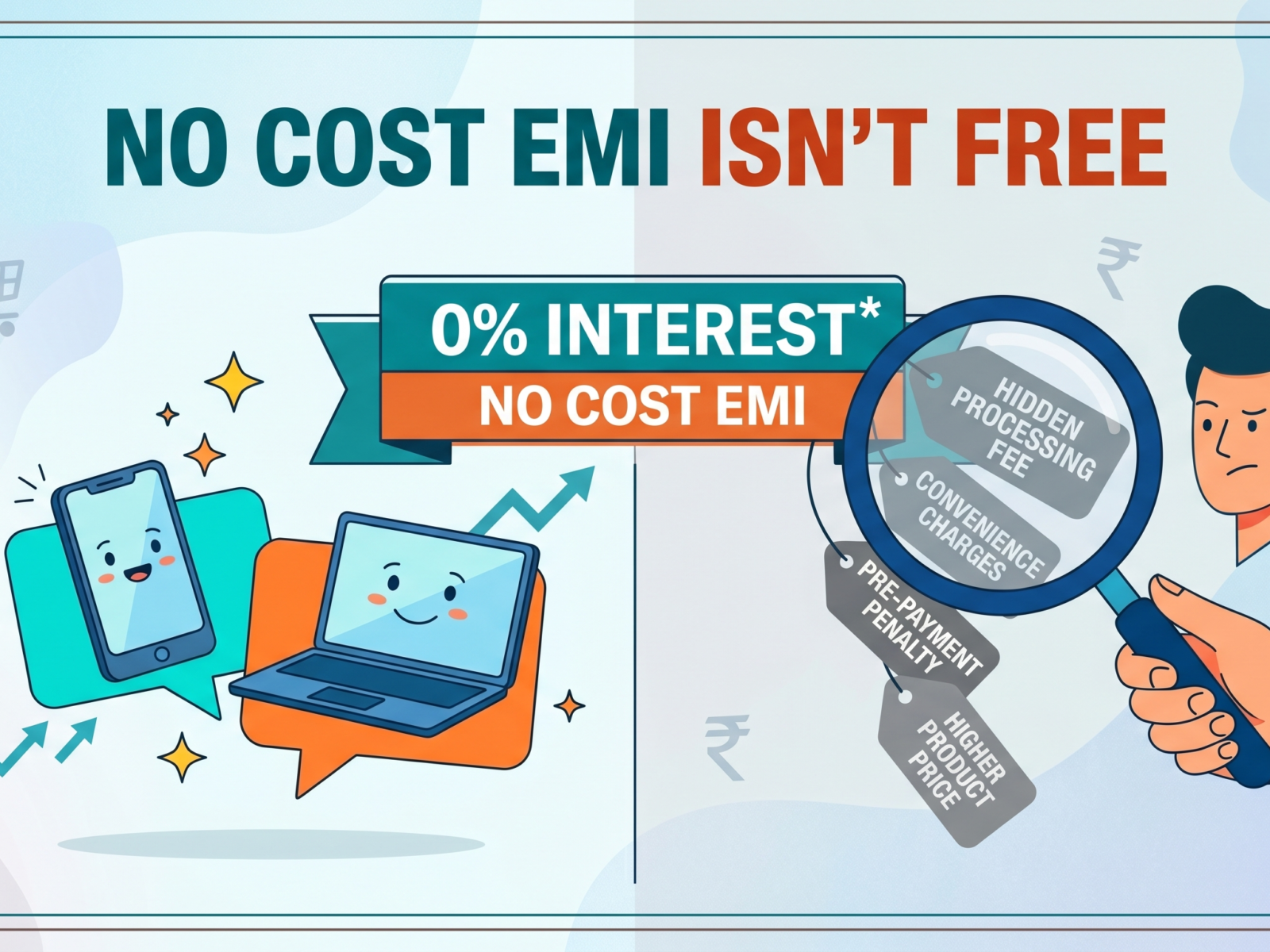
Here’s who actually pays.
Everyone loves “0% interest.” Someone in the chain is always paying it — and once you see the money move, you can’t unsee it.
You walk into a store, pick a ₹60,000 phone, and the salesperson says the magic words: “No-cost EMI — just ₹5,000 a month for 12 months, zero interest.” You pay exactly ₹60,000 over a year. Nothing extra. It feels like the bank is lending you money for free.
It isn’t. Banks don’t lend at 0%. The interest on that loan is very real — it has simply been paid by someone else, before you ever saw the price tag. Understanding who, and how, is the difference between a smart purchase and a quietly expensive one.
“No-cost EMI” is more honestly read as “someone-else-paid-the-cost EMI.”
The money actually moves like this
Three parties sit in every no-cost EMI transaction. The lender charges its normal interest. The catch is where that interest comes from.
The three-party flow
The bank still earns ~14–16% interest. The merchant pays it on your behalf as an upfront “subvention” discount, so your outflow is just the sticker price.
This payment from merchant to lender is called subvention. The merchant effectively buys down your interest out of its own margin, because a no-cost offer sells more phones, at higher ticket sizes, to more people. Your “free” credit is a marketing cost on the merchant’s P&L.
So where does the cost hide?
If the merchant funds the interest, the ₹60,000 you pay is genuinely all principal. But three smaller costs often leak back to you, which is why “no-cost” rarely means “zero cost”:
What ₹60,000 of “no-cost EMI” really contains
The interest block never touches your wallet — but a one-time processing fee (₹199–₹999 typical) and GST on the interest component frequently do.
There’s also a fourth, invisible cost: the discount you didn’t get. A cash buyer can often negotiate 3–5% off. Choose no-cost EMI and that lever usually disappears — the merchant has already spent its margin subsidising your instalments.
No-cost EMI vs the alternatives
It helps to see where it sits against regular EMI and BNPL — because the funding source is what really separates them.
Who funds what
| No-cost EMI | Regular EMI | BNPL | |
|---|---|---|---|
| Who pays the interest | Merchant | You | You / merchant |
| Cost to you | Fee + GST only | Full interest | Varies; late fees bite |
| Cash discount kept? | Usually lost | Often kept | Mixed |
| Best when | Big planned buy | You want lowest sticker | Small, short-term |
Illustrative — exact fees, tenures and rates vary by lender, merchant and RBI disclosure rules at the time of purchase.
The operator’s read
Having sat on the merchant side of these deals, here’s the honest framing. No-cost EMI is genuinely good for you when you were going to buy the thing anyway, the processing fee is small, and you’d not have gotten a meaningful cash discount. You get to keep your capital and pay over time, for almost nothing.
It works against you when it nudges you into a bigger purchase than you planned, when the fee and GST quietly stack up across several buys, or when you’d have negotiated cash off. The offer is engineered to lift the merchant’s conversion and average order value — that’s the whole reason it exists.
Free credit is never free — it’s just someone else’s line item.
In no-cost EMI, that someone is usually the merchant, funding your interest to win the sale. Knowing that, you can use it as a genuinely smart tool — or spot when it’s quietly costing you the discount you never asked for.
Note for publishing: figures here (rates, fees, tenures) are illustrative — verify against current lender terms and the latest RBI disclosure norms before going live, and we can add a real worked example with live numbers.